Report
Sharjah Police Bust Four Gangs in Cyberattack and Crypto Money-Laundering Operation
Police report more than Dh200 million seized in Operation End of Battle, with over 30 organisations protected and assets worth more than Dh65 billion safeguarded.
BREAKING NEWS · POLICE ACCOUNT
Published 15 October 2026 · Sharjah, United Arab Emirates

Photo: Sharjah Police / Instagram, according to the supplied caption. This photograph does not depict the arrests.
Four interconnected networks dismantled
According to the supplied account of a Sharjah Police briefing, officers dismantled four interconnected international criminal networks linked to an alleged Dh8.8 billion money-laundering operation involving cryptocurrency theft, hacking, fraud and violent attacks on digital-wallet holders.
The operation, named End of Battle, reportedly led to the seizure of more than Dh200 million in funds and assets and the referral of 33 accused individuals and companies, including six corporate entities, to the Sharjah Criminal Court. The 33 total includes companies and must not be read as 33 people arrested. Officials said the individuals represented 12 nationalities; this does not identify 12 case locations.
Lieutenant General Abdullah Mubarak bin Amer, Commander-in-Chief of Sharjah Police, said the operation protected more than 30 companies and institutions worldwide, safeguarding assets valued at more than Dh65 billion. Those safeguarded assets are distinct from the seized assets and the alleged laundering amount, and must not be added together.
Crime Watch Global thanks readers
Crime Watch Global would like to thank everyone who brought tips to us. We say that we passed information to UAE authorities and believe it contributed to the arrests reported in this operation. We appreciate those who shared credible information and the authorities who investigated.
This acknowledgment is a publisher statement. The supplied police account credits cooperation between federal, local and international authorities but does not independently establish that Crime Watch Global's tips caused or contributed to these arrests.
The police account supplied to Crime Watch Global
The following detailed account was supplied by the publisher and attributes its findings to Sharjah Police and Sharjah Public Prosecution. A direct link to the original news article was not supplied; the figures and proceedings are reported here as attributed claims, not independently authenticated court findings.
Sharjah Police have dismantled four interconnected international criminal networks linked to an alleged Dh8.8 billion money laundering operation involving cryptocurrency theft, hacking, fraud and violent attacks on digital wallet holders.
The operation, named ‘End of Battle’, led to the seizure of more than Dh200 million and the referral of 33 accused individuals and companies to the Sharjah Criminal Court. The accused include six corporate entities, while the individuals involved represent 12 nationalities, officials said.
Details were announced at a media briefing held at Sharjah Media City (Shams) Thursday. Police described the case as the biggest in the force’s history and one of the most complex cross-border organised crime investigations worldwide.
Lieutenant General Abdullah Mubarak bin Amer, Commander-in-Chief of Sharjah Police, said the operation helped protect more than 30 companies and institutions around the world and safeguard assets valued at over Dh65 billion. It also prevented potential economic repercussions for global digital asset markets.
More than 3,000 digital wallets were subjected to scrutiny and verification as investigators traced the networks’ activities and financial links.
Four networks, separate roles
Major General Omar Ahmed Balzoud, Director-General of Criminal Security and Ports at Sharjah Police, said the organisation did not rely on a single criminal method. Instead, four interconnected networks carried out different stages of the alleged offences.
The first specialised in hacking and stealing data. The second laundered proceeds through virtual assets. The third used social engineering, manipulating victims into disclosing information or taking actions to steal from digital wallets.
The fourth carried out violent physical assaults to force victims to reveal their wallet passcodes. Officials said victims were also threatened, and their relatives were threatened or harmed, in incidents spanning several countries inside and outside the UAE.
This division of roles allowed the organisation to target individuals, businesses and institutions across borders while making its structure and leadership harder to identify, police said.
Minor suspect provided an early lead
Brigadier Dr Khalifa Balhai, Director of the Criminal Investigation Directorate at Sharjah Police, said investigators reached a minor suspect after tracking the organisation’s activities and analysing its members’ movements.
The young suspect was found with a digital wallet holding substantial funds. Investigators established alleged links to international groups specialising in digital wallet theft and said he played an important role in laundering virtual assets for people involved in fraud, hacking and cyber extortion.
The initial police presentation described the young suspect as possessing advanced digital skills, an understanding of financial markets and knowledge of how money was managed.
Further surveillance identified a key intermediary connecting the networks. Police said he worked with the young suspect to launder cryptocurrency and conceal financial movements, and was allegedly involved in assault, kidnapping, digital wallet theft and possessing and selling stolen data on the dark web.
Investigators also linked him to international groups involved in hacking, extortion and online fraud. Teams studied his behaviour and movements before drawing up a plan to arrest him and pursue the wider organisation.
Kidnap and killing plots thwarted
Investigations uncovered a plan to target people who owned digital wallets, with the intermediary allegedly working alongside a group of foreign nationals to kidnap the intended victims. Police said officers arrested the suspect and prevented the plot from being carried out.
Balzoud also said the operation prevented a plan to kill a member of the organisation who owned a digital wallet. The arrests stopped the planned killing from taking place in the UAE, he said.
Police distinguished these thwarted plots from violent offences they said had already been documented in the UAE and abroad.
Code changed every eight hours
Investigators traced the suspects to a concealed group on a social media platform, helping establish their relationships and individual responsibilities. The group used a code that changed every eight hours to protect its communications, officials said.
The organisation operated through a tightly structured hierarchy, with leaders and members assigned specific, interconnected tasks. Its activities were hidden behind encrypted layers and closed online networks accessible only to members.
Some suspects allegedly hacked systems and stole databases, then passed the information to others who managed, sorted and offered it for sale on the dark web. The stolen data was also used in phishing and fraud through social engineering supported by artificial intelligence tools.
Other members contacted victims and induced them to transfer funds, using threats and violent assaults to force compliance, according to police.
A separate part of the organisation managed digital assets and wallets, receiving cryptocurrency taken from victims before redistributing, transferring and laundering it through virtual assets. The proceeds were ultimately passed to members according to their roles.
Billions moved through accounts and wallets
Sharjah Public Prosecution put the value of funds involved in the alleged money laundering offences at Dh8,825,381,741.50, approximately Dh8.8 billion.
Sharjah Attorney General Anwar Amin Al Harmoudi said the organisation’s activities followed a connected chain deceiving victims and hacking their accounts, taking their money and digital assets, concealing the proceeds, and converting them into property and investments to give them an appearance of legitimacy.
Funds were routed through bank accounts, digital wallets and multiple platforms, with companies and intermediaries used to disguise their movement. They were then invested in property, luxury cars, expensive watches and jewellery.
The scale of the funds, the organisation’s structure and the speed of cross-border transfers made the money harder to trace and complicated efforts to identify its ultimate beneficiaries, prosecutors said.
Luxury lifestyle concealed criminal proceeds
Police said the suspects presented themselves as businesspeople and investors, travelling between international capitals and displaying wealth while allegedly operating criminal activities in secret.
The opening presentation described luxury cars, private aircraft, valuable jewellery and high-end property. Investigators said the extravagant lifestyles concealed a financial operation built on unlawful proceeds.
Raids and searches uncovered digital wallets through which billions had moved, along with cash, electronic devices and other assets valued in the hundreds of millions of dirhams. Some of the currency recovered was genuine and some counterfeit, with police saying fake notes were used in fraud.
Balzoud said officers also placed a luxury residence in Dubai under seizure as they traced the organisation’s property holdings.
Assets seized or attached included 17 luxury cars, 29 expensive watches, jewellery, a residential villa, two villas under construction and two residential plots.
Searches also uncovered cold digital wallets devices used to store cryptocurrency credentials offline drugs, counterfeit currency and counterfeiting equipment.
Police put the overall value of confiscated funds and assets at more than Dh200 million.
More than 10,000 documents examined
Prosecutors conducted legal, digital and financial investigations in parallel to establish the organisation’s structure and trace its proceeds.
The team examined more than 10,000 documents and reports, carried out 142 investigation records and sessions, issued 385 decisions and 478 judicial orders, and analysed 103 electronic devices.
The proceedings also involved 12 search authorisations, 109 requests coordinated with the Financial Intelligence Unit, and eight requests or procedures for international cooperation.
Judicial, security, technical and regulatory bodies worked together to establish the suspects’ roles, trace financial movements, freeze accounts and locate assets linked to the accused.
A representative of Sharjah Public Prosecution who presented its findings at the briefing said the accused had been referred to the Sharjah Criminal Court.
Suspects brought back from abroad
Balzoud said the investigation involved Sharjah Police, the Ministry of Interior and other security agencies, with Interpol helping track suspects outside the country.
Key suspects were located abroad and brought back to the UAE, where evidence against them was documented and submitted to prosecutors. Police said the operation dismantled the four networks and led to the arrest of their leaders and members.
Teams monitored movements, analysed criminal patterns and connected digital and financial evidence, working through hundreds of pieces of evidence to identify the networks’ leaders and members.
Bin Amer credited cooperation between federal, local and international bodies, supported by the Ministry of Interior and Sheikh Saif bin Zayed Al Nahyan, Deputy Prime Minister and Minister of Interior.
“What has been achieved in this case is the result of integrated institutional work, sustained security efforts, and close cooperation and coordination with federal, local and international authorities,” he said.
He said the operation went beyond arresting suspects and stopping their activities, extending to protecting assets and limiting potential economic and security consequences.
Bin Amer also praised the role of prosecutors and the judiciary, and said anyone exploiting digital technology to commit crimes would face a security system equipped to track them down and bring them to justice.
Photographs supplied with the report
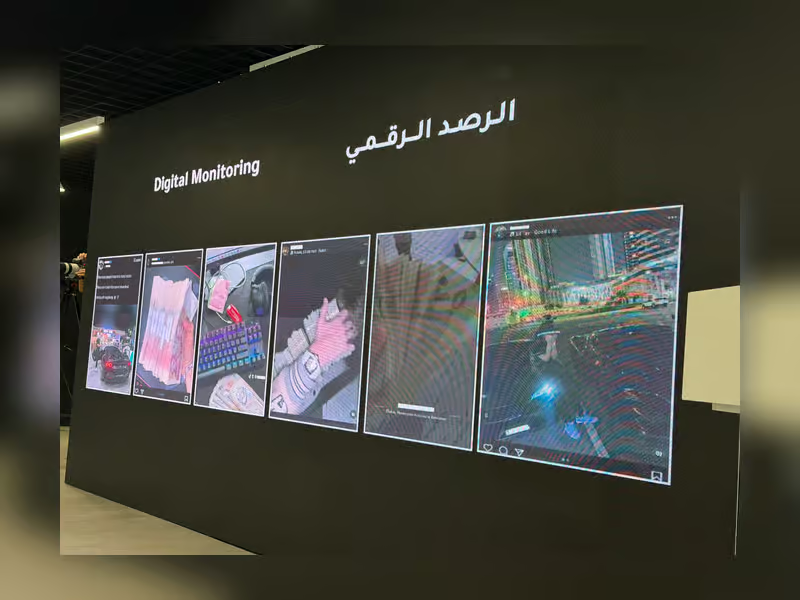
Digital-monitoring display at the police briefing. Photo: Ruqayya Alqaydi, according to the supplied article captions; image-by-image attribution has not been independently verified.
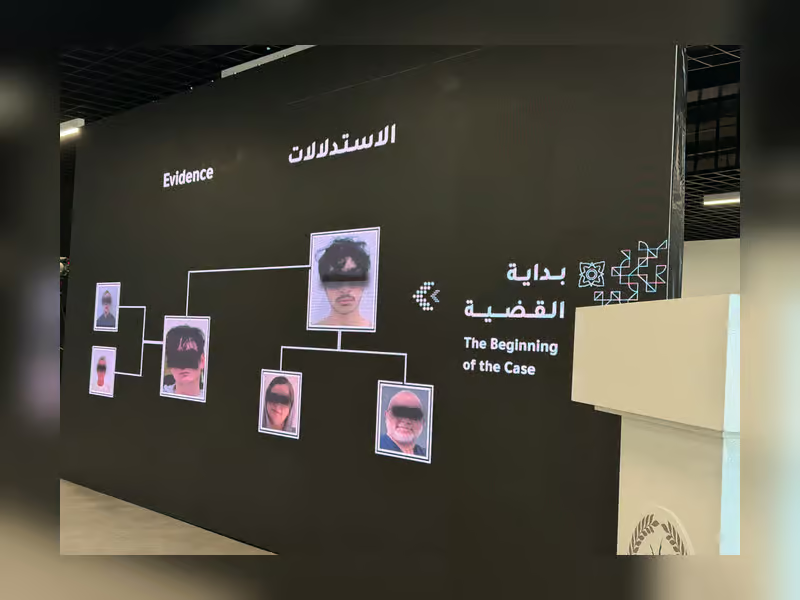
Evidence and beginning-of-case display at the police briefing. Photo: Ruqayya Alqaydi, according to the supplied article captions; image-by-image attribution has not been independently verified.
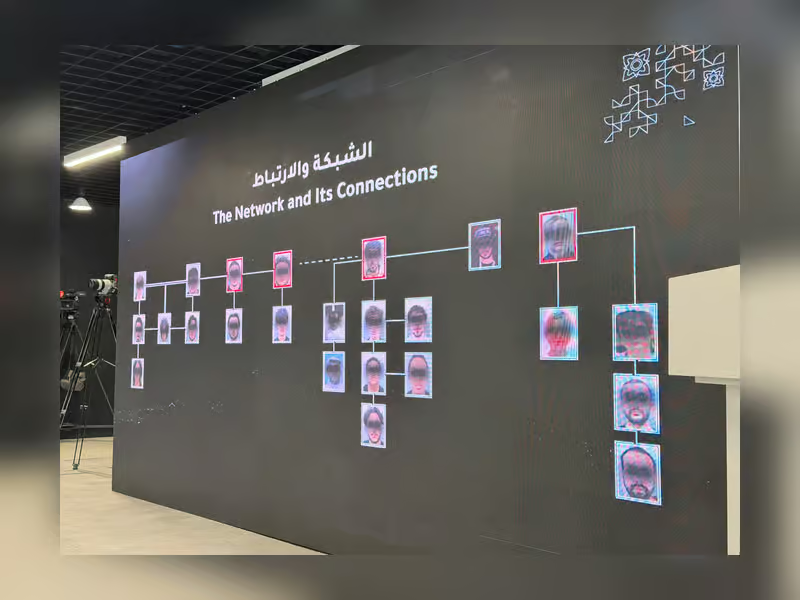
Network-and-connections display at the police briefing. Photo: Ruqayya Alqaydi, according to the supplied article captions; image-by-image attribution has not been independently verified.
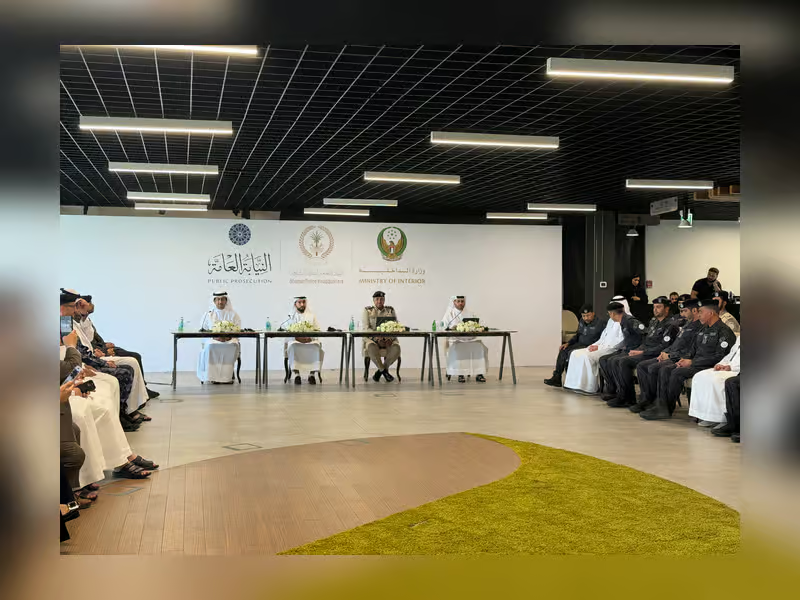
Sharjah Police media briefing. Photo: Ruqayya Alqaydi, according to the supplied article captions; image-by-image attribution has not been independently verified.
Legal status and scope
Arrests, referrals and prosecution allegations are not convictions. The supplied account does not report a final judgment. No connection between this police operation and the separate, unnamed football-club allegations has been established.